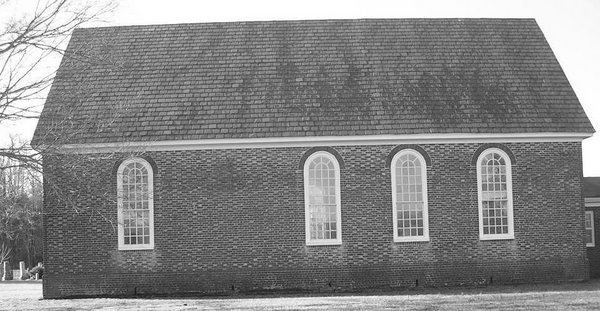
- 1636 New Norfolk County separated from Elizabeth City county
- 1637 New Norfolk County divided into Lower Norfolk and Upper Norfolk Counties
- 1640 Lower Norfolk Parish established
- ? Lower Norfolk Parish sub-divided into Elizabeth River, Lynnhaven, and Southern Shore Parishes (Rawlings says "soon divided" (p. 153))
- 1691 Lower Norfolk County split into Norfolk and Princess Anne Parishes
- 1695 Lynnhaven and Princess Anne Counties merged
- 1761 Portsmouth Parish and St. Bride's Parish split from Norfolk and Princess Anne
Saturday, October 25, 2008
St. Paul's Church, Norfolk Virginia
Tuesday, April 1, 2008
St Paul's Parish Church, King George County


I wondered about the state of this church after reading about it, but was pleasantly surprised to find the brickwork in better condition than I thought although the classic purity of the architecture is ruined by the bricking up of the original, huge doorways and the insertion of rectangular doors in the wing in the early Nineteenth Century.
The building immediately gives the impression of immensity in both width and height. It is in the shape of an equal armed cross (a Greek cross) with dimensions of 61' 10" for the each total side with the arms being 20' 10" wide and 16' in length from the center. Like Aquia Church and several Northern Virginia ones (Pohick, Christ Church Alexandria, Falls Church), St Paul's has two stories of windows: the lower being rectangular with segmental arches, the upper typical compass windows. The walls seem quite high, some 25 feet at least so the total effect is of an imposing edifice. The brick is laid in English bond in the water table and Flemish bond above it. The transition from the water table to the walls is via a beveled brick. Rubbed brick is used at the corners and around the windows while the use of glazed brick is irregular and sparse. The walls are 21" thick.
Thursday, March 27, 2008
Fork Church


Fork Church is a charming rectangular church located close to Richmond at the western end of Hanover County. To reach it go north on Route 1, paralleling I-95 to the west, and turn west on Routh 738 for a refreshingly bucolic trapse.
It is slightly larger than typical churches at 74’ x 34’ and has gorgeous brickwork noted by Rawlings (1063 142ff). The bricks are laid in Flemish bond with glazed headers throughout. A supremely ugly brick chimney is placed between the two chancel windows. The water table seems relatively high (I should have measured it.) and is laid in English bond. Beautifully toned rubbed brick marks the corners and the windows with some regularity. On the spring day we visited, the light brought out all the subtleties in those tones from deep red to rosy red. The windows themselves are in the form of beautifully proportioned segmental arches. The brickwork at the east and west end tops is obviously replaced; Rawlings hypothesizes this as evidence of original clipped gables (143).
The doorways have been altered by the addition of cumbersome, pillared porches with crude triangular roofs and equally clumsy decorative eaves (modillions) and matching half-columns (pilasters) on the walls. The columns are made of white painted brick and taper from bottom to top (classical entasis). Rawlings dreams fruitlessly of the restoration of the original doorways in his 1963 text (144).
For lovers of intricate window frames, this is Elysium. Rawlings describes them in some detail on page 144. I should have thought to take close-up pictures of them. Maybe next time.
The pews are largely original but substantially altered in height from a 1930 remodeling while the pulpit was moved from the north to east to north again. The oak floors are very likely original; this church never had the common flagstone floors typical of most colonial churches. There is a west gallery that is original along with an organ from the mid nineteenth century (Rawlings 145).
There is a large marble font from Mattaponi Church in King and Queen County, but no parish silver as it was destroyed in a 1936 fire.
The churchyard has many internments but none of colonial times and has the strangest, most clumsy wall around some of the older graves. It was erected from the east end of the church ten or so feet from the chancel wall and runs in a thin rectangle for a hundred feet or so. The brickwork in the wall is sloppy and irregular as is the wall capping. The graveyard, though, is worth a good hour of exploration.
Dolley Madison and Patrick Henry along with the novelist Thomas Nelson Page at least occasionally attended here and the actress Katherine Hepburn’s grandfather, S. S. Hepburn, was rector from 1893 to 1903.
All in all, Fork Church is a charming edifice with admirable brickwork. As a editing experiment, the first image shows the east edifice without the chimney.
Wednesday, March 26, 2008
Slash Church


Slash Church is in a rarity of three in Virginia: a clapboard church surviving from colonial days. Remarkably close to Richmond, it has survived relatively intact except, as in most pre-revolutionary places of worship, having massive alterations to the interior configuration. It is easy to find; take the 656 exit on I 95 North of Richmond straight along Sliding Hill Road until it turns into Mt. Hermon Road. The term slash refers to elevated areas in the generally swampy terrain (similar to lights in the Great Dismal Swamp).
The original building, with a similar , but separate structure added a few feet to the north of it in 1955, is surprisingly intact with the clapboards showing inevitable wear yet still relatively undamaged. Its measurements are 60’ x 20’ (measured by Rawlings as 60’ 7” x 26’ 6’’ – as if it changed in post colonial construction?). This makes it just average in size for a rectangular church. Rawlings claims, too, that only isolated clapboards on the east, south and west walls are original while the present pastor asserts that they are largely original with the exception of the northeastern wall which was damaged in a fire in the 1970s along with the floor in the same area. Standing on the top of a small rise to the northwest of Mt. Hermon Road in Hanover County, the first impression is of a pair of buildings similar in construction and proportion to a colonial edifice. It is quite charming and reminds the viewer of stereotypical country churches.
The doors are of simple construction and the west door is of colonial origin as are the sills of the two lower east windows. The eaves contain a toothed decorative motif (modillion cornice) that is original and, in 1963, the interior wainscoting, the handrail, and the west gallery that the pastor claims is structurally sound despite seeming slightly askew. The original wooden foundation sills are still intact but have been set on brick foundations.
Rev. Steve Lesher was kind enough to leave his Bible study group to let us inside and lead Tom, Bill, and me on a guided tour of the inside. The present congregation is vigorous and, pleasingly, composed of both old Hanover residents as well as a sizeable proportion of young families with children filling the building each Sunday. It is good to see these venerable structures still alive and thriving. Their denomination is the Disciples of Christ whose stark worship resembles that of the Anglican simplicity of the Eighteenth Century.
If I make it back again to this church, I will beg to be allowed to stand on a stepladder and see the roof structure which consists of diagonal purlins and beams fastened with wooden pegs that Rawlings says “are arranged in a curious, triangular form . . . [with] no ridge beam.” (104).
Dolley Madison, Patrick Henry, and Henry Clay are claimed as members of this parish, and Henry’s uncle was rector for forty years. Nearby Fork Church also claims Patrick Henry as a communicant? The building was abandoned after the Revolution and was shared by the Methodists and Disciples of Christ until 1842 when the latter denomination acquired its sole use. It was supposedly used as a school and a Civil War hospital? There also was a significant skirmish between Confederate and Union troops on May 27, 1862 in one of the first skirmishes of the Seven Days Battle.
Monday, November 26, 2007
Aquia Church


39 27' x 77 24': This church is located just off Route 95 and US Route 1 in Stafford Virginia. It is one of the easiest churches to find as the interstate exit, accessible from north or south, is labelled Aquia Harbor. The church is immediately north-east of the first light off the exit from 95.
This is truly a splendid building. According to Rawlings (184ff), the brickwork dates from 1751 to 1757 and was destroyed by Union soldiers during the Civil War. The walls as well as the interior have been rebuilt to the pre-Revolutionary War state sometime around 1915-16. Large patches of the walls are obviously rebuilt, in some cases carelessly even to my non-architect's eye. Apparently there was a coat of yellow paint on the building as recently as 1933.
Aquia is a true cruciform church with the walls 64' both east-west and north-south. Each arm is approximately 16' 2 1/2" long with a width of 32' 4". The walls are 24 1.2 " thick. Unlike Abingdon or Lancaster Churches, while in the interior, one can clearly see the cruciform structure, probably due to its Greek Cross construction. Like few colonial edifices, it has two levels of windows with the lower ones being rectangular with a keystone and angled soldiers and the upper being of typical compass construction. The front, west facade is two stories with a tower with a complicated cornice (See Rawlings 190).
It is surrounded by an attractive churchyard with many curious graves of colonial and modern origin.
In a later posting, I will describe the interior and many lurid stories surrounding the church.
This is a must visit.
Sunday, July 15, 2007
Westover Parish Church


N37.33120 W77.15853 1731 Erected 1731
This rectangular church, like most, is not the first near the site but the exterior in general remains in a state of remarkable preservation. It is located a half-mile or so to the east of Route 5t in a grove of trees beyond a brick and iron gateway. A colonial cemetery surrounds the church and the later, but matching, rectory buildings within the churchyard.
The parish itself is one of the oldest in America, dating from the mid 1620s and, in the early days, encompassed the land on both sides of the river until the establishment of parishes on the other side of the river. Most likely the present edifice was moved after permanent churches were built in surrounding areas.
Thursday, July 5, 2007
Old Donation Church


Old Donation Church (3rd
The church is 65’ x 30’, so it is a tad larger than the average colonial one and laid with English bond in the water table and Flemish bond above it. The walls are 18” thick and, according to Rawlings, were originally higher by thirteen courses than they are presently. The walls show much evidence of rebuilding from an 1882 forest fire that destroyed all but the walls. A picture posted on the church’s web site shows utter destruction. http://www.olddonation.org/history.htm. The 1912 reconstruction of the church greatly altered its colonial character by using glaringly different brick and adding an entrance door (reminiscent of Upper Chapel, Middlesex) and a southern vestry addition. There is a dating brick by the western doorway with the year 1736 on it. The windows are the area of principal interest as the small windows in the northern and southern walls were inserted to accommodate the construction of private hanging pews for wealthy members of the congregation. What is surprising is that there are so many of them.
Tuesday, May 29, 2007
Cattail Church


N37.75761 W77.13587 1751
Cattail Church, what is left of it, is in King William County at the end of a country lane in a suburban looking neighborhood. When we first saw it, we thought it was a nineteenth century church as the brick was overlaid with a thick layer of stucco, steeples with bizarre spikes have been added, the original rectangular room-church was shortened, and an addition was erected at the eastern end of the edifice. The buttresses, reminiscent of St. Luke's in Smithfield are a non-original addition. On close inspection, the bevel of the water table can be identified; all else, including the window frames, is substantially altered. As reported by Rawlings in 1963, several benches may be original (he cites four of them), and, indeed, Tom and I saw what seemed to be an old bench left out in the open portico east of the church that seemed to have been left there for some time.
Its original dimensions were most likely 60' x 30'; the more or less standard size for rectangular room churches. There is little for the student of colonial churches here. Note the curious quoins on the north steeple opposite the triangular cap for the southern one. In Rawlings' account, he mentions that the steeples are painted green although they are now silver. Cousin Tom mentions that European steeples are invariably green. Does anyone have documentation or a raison d'etre for green steeples?
The surrounding graveyard, begun by a local Black Baptist congregation, has numerous internments and curious features such as grave slabs and concrete crosses on many of the graves. Rawlings calls the church ". . . curious and lamentable" (184) while Upton has eliminated it from architectural analysis completely.
Sunday, May 13, 2007
Vauter's Church


Vauter's Church (Vawter's) 1719-1731 N38.08642 W77.06798
This delightful building lies just to the north of Route 17 in Essex County between Port Royal and Tappahannock. There are several interesting features of the structure, so I will post different blogs about the exterior, the interior, and the stories about the church.
Vauter's Church is a T-shaped building with the offset to the south -- the best preserved church of its type in the USA. It is the fourth (?) building of St. Anne's Parish and the first brick church of the parish. St. Anne's Parish was founded circa 1704-1711. Rawlings and Upton both consider this church as a modified one with the basic rectangular structure erected around 1719 and the southern T erected in 1731 according to the dating brick. The present rector, Dr. Agnew, states from his examination of the rafters on a crawl though them that the structure was originally erected as a T-shaped structure in 1731?
In any case, the location of the church on a small knoll surrounded by picturesque trees and a small graveyard, makes this the most pleasing site I have visited so far. The rectangular east-west structure is 56'6" x 30'2" -- of average size -- while the T-wing is 30'2' wide by 16' long. The T of the chancel is 10'3" wide. Rawlings cites the irregular placement of the southwest windows so that the shutters overlap and irregular flagstones in the aisles as evidence of later construction of the south wing. I, sadly, didn't think to examine them. The walls are 2' thick.
The walls are in superb shape with the checkering of the glazed brick particularly noticeable. The water table is beveled with the expected English bond below and Flemish bond above. A small number of glazed headers are used in the water table itself. Along the angled rafters of the roof (barge boards) is a row of glazed headers as, to a disorganized extent, in Yeocomico and, in a similar manner, in St. John's, King William. Rubbed brick is present in doorways and window jambs, and there is as well fairly consistent use of queen closers in doorways and windows.
The doors themselves are possibly the oldest ones in the state; an interesting feature of the south doors is that they seem to have been put on backwards -- the door panels are concave instead of convex and the weathering on them suggests that they were always that way. the size and spacing of the arches shows great craftmanship. The south door has a triangular pediment while the west door has a semicircular arch as seems typical in these Northern Peninsula churches compared to those south of the James. The pilasters also show great evidence of symmetry and master brickwork.
The windows have circular (compassed) arches with some replacements in the arches. The west facade has two small windows for the balcony that are square with semicircular arches. The roof appears at first to have a consistent angle but is actually kicked gently at the eves, giving it a graceful look.
All in all, this church is beautifully preserved in an idyllic setting and a must visit. It is still an active congregation, and while, we were there, a tour bus arrived, and we were invited by the genial pastor and visitors to tag along with them.
The
Saturday, April 28, 2007
St Mary's Whitechapel


St Mary's Whitechapel N37.74731 W76.55239 1740-1741
This church is presently a rectangular structure that has endured transitions from its first erection: in 1669 it was erected as a rectangular edifice, transepts were added in 1740 to make it a cruciform church, and in 1832 all but the nave and chancel were demolished. Thus the present church bears little relation in its structure to either church, and it is hard to see, while visiting the site, the exact relationship of the present edifice to the original church. Tom and I had to walk around the site several times and consult the kiosk before we could picture the site of the original church. This isn't helped by the ungainly south porch that is an ill match to the building both in its proportions and details. To view the dimensions of the original church, it is necessary to stand in the set of hedges where the chancel used to stand and mentally rotate the cruciform structure.
The brickwork is in Flemish bond with glazed headers and English bond below the beveled water table. There is evidence of numerous repairs and alterations to the walls. Windows on the ends and the north wall are believed to be original. They are compass framed with semi-circular arches. The southernmost window on the east wall is said to be original by Rawlings (1963, p. 164) while the north windows have original sills (Ibid).
We were unable to get to the interior as the building was locked, but the most appealing attributes are an ancient baptismal font (1718) and a set of chancel tablets bearing the Ten Commandments, the Lord's Prayer, and the Apostle's Creed dating from 1702 and 1718. The chalice, paten, and other silver are from 1669 along with Wicomico's silver from
1711 to 1729 are also part of the parish's interior appointments. Characteristically, the panels and silver from this parish are prominently inscribed with the donating family, the Foxs, reminding me of the essential hubris of Lancaster Church.
This is still an active church with a tasteful set of parish buildings across the parking lot from the church and extensive graveyard.
Saturday, April 21, 2007
Christ Church, Lancaster


The doors themselves are elaborate and massive. The most awe-inspiring is the west doorway that is 21’ high and has an even larger, intricate pediment. A picture alone can not do it justice. The doors on the north and south transepts are equally as impressive.The Carter tombs on the east side of the church are of marble and feature elaborate carvings of colonial motif cherubs and death heads.
I won’t even touch the inside of the church until I make a visit later this year.The general impression this edifice gives me is one of hubris: Carter meant not only to show faith, if he meant to show it at all, but rather to render his exalted position in the colony. It fits such detail in other churches as conspicuously exhibiting a patron’s name or initials on such donatives as wall plaques or communion silver. Dell Upton calls the rising Virginia a “proud and unlovely people.” It aptly describes the tone of the church. Shelley also wrote about this idea in “Ozymandias” – “Look upon my works, Ye mighty, and despair!” Read the poem for an apt conclusion.Extensive information from the Foundation for