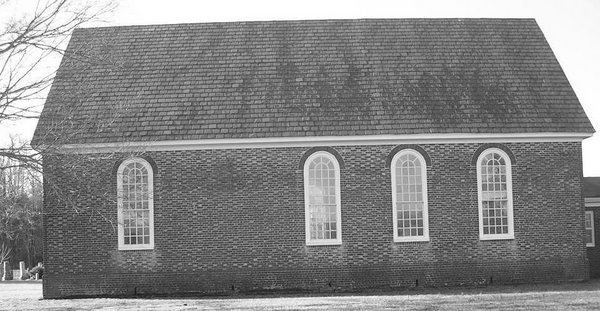
- 1636 New Norfolk County separated from Elizabeth City county
- 1637 New Norfolk County divided into Lower Norfolk and Upper Norfolk Counties
- 1640 Lower Norfolk Parish established
- ? Lower Norfolk Parish sub-divided into Elizabeth River, Lynnhaven, and Southern Shore Parishes (Rawlings says "soon divided" (p. 153))
- 1691 Lower Norfolk County split into Norfolk and Princess Anne Parishes
- 1695 Lynnhaven and Princess Anne Counties merged
- 1761 Portsmouth Parish and St. Bride's Parish split from Norfolk and Princess Anne
Saturday, October 25, 2008
St. Paul's Church, Norfolk Virginia
Tuesday, April 1, 2008
St Paul's Parish Church, King George County


I wondered about the state of this church after reading about it, but was pleasantly surprised to find the brickwork in better condition than I thought although the classic purity of the architecture is ruined by the bricking up of the original, huge doorways and the insertion of rectangular doors in the wing in the early Nineteenth Century.
The building immediately gives the impression of immensity in both width and height. It is in the shape of an equal armed cross (a Greek cross) with dimensions of 61' 10" for the each total side with the arms being 20' 10" wide and 16' in length from the center. Like Aquia Church and several Northern Virginia ones (Pohick, Christ Church Alexandria, Falls Church), St Paul's has two stories of windows: the lower being rectangular with segmental arches, the upper typical compass windows. The walls seem quite high, some 25 feet at least so the total effect is of an imposing edifice. The brick is laid in English bond in the water table and Flemish bond above it. The transition from the water table to the walls is via a beveled brick. Rubbed brick is used at the corners and around the windows while the use of glazed brick is irregular and sparse. The walls are 21" thick.
Monday, November 26, 2007
Aquia Church


39 27' x 77 24': This church is located just off Route 95 and US Route 1 in Stafford Virginia. It is one of the easiest churches to find as the interstate exit, accessible from north or south, is labelled Aquia Harbor. The church is immediately north-east of the first light off the exit from 95.
This is truly a splendid building. According to Rawlings (184ff), the brickwork dates from 1751 to 1757 and was destroyed by Union soldiers during the Civil War. The walls as well as the interior have been rebuilt to the pre-Revolutionary War state sometime around 1915-16. Large patches of the walls are obviously rebuilt, in some cases carelessly even to my non-architect's eye. Apparently there was a coat of yellow paint on the building as recently as 1933.
Aquia is a true cruciform church with the walls 64' both east-west and north-south. Each arm is approximately 16' 2 1/2" long with a width of 32' 4". The walls are 24 1.2 " thick. Unlike Abingdon or Lancaster Churches, while in the interior, one can clearly see the cruciform structure, probably due to its Greek Cross construction. Like few colonial edifices, it has two levels of windows with the lower ones being rectangular with a keystone and angled soldiers and the upper being of typical compass construction. The front, west facade is two stories with a tower with a complicated cornice (See Rawlings 190).
It is surrounded by an attractive churchyard with many curious graves of colonial and modern origin.
In a later posting, I will describe the interior and many lurid stories surrounding the church.
This is a must visit.
Saturday, April 21, 2007
Christ Church, Lancaster


The doors themselves are elaborate and massive. The most awe-inspiring is the west doorway that is 21’ high and has an even larger, intricate pediment. A picture alone can not do it justice. The doors on the north and south transepts are equally as impressive.The Carter tombs on the east side of the church are of marble and feature elaborate carvings of colonial motif cherubs and death heads.
I won’t even touch the inside of the church until I make a visit later this year.The general impression this edifice gives me is one of hubris: Carter meant not only to show faith, if he meant to show it at all, but rather to render his exalted position in the colony. It fits such detail in other churches as conspicuously exhibiting a patron’s name or initials on such donatives as wall plaques or communion silver. Dell Upton calls the rising Virginia a “proud and unlovely people.” It aptly describes the tone of the church. Shelley also wrote about this idea in “Ozymandias” – “Look upon my works, Ye mighty, and despair!” Read the poem for an apt conclusion.Extensive information from the Foundation for
Thursday, April 12, 2007
Farnham Church


Farnham Church N37.88579 W76.62508 1737
This cruciform church stands in the middle of a small village in Richmond County just north of Route 3. Is is a Latin cross with general dimensions of 63'8" x 58'2". The nave is 24'3", the chancel 14' long while the transepts are 16'7" long. The extensions of the cross are all 25' wide. Reportedly the walls are 2' thick (all from Rawlings, 1963). I believe I read somewhere that Christ Church in Lancaster County was specifically referred to as the model for this church.
The brickwork has been repointed or replaced at several places, and the gables seem to have been rebuilt completely. Rawlings asserts that the roof was originally hipped like Lower Middesex Church. (Should I get a drawing program and produce a hypothetical hipped structure?) The doorways seem to have been completely replaced with modern reproductions for which the frames were obviously cut and new work inserted. The water table, in English bond, has a subtle cavetto and ovolo pattern while the wall bricks are laid in Flemish bond with glazed headers. For some reason (?), the chancel windows have been cemented in a similar manner to those of Chuckatuck church.
While Tom and I were there, two bricklayers were setting a new walk from the north doorway, and we engaged them in conservation. If the local man who was working there reads this, we implore him to keep his distinctive, fascinating local dialect (accent). I got the other man talking, and we had, for me at least, a most interesting talk about the competence of colonial craftsmen -- he gives them a most high rating -- and the features such as the gauged brick voussiors above the windows and doors that demanded considerable skill and meticulous attention to detail. His opinion was that it actually would take only a few months to actually erect the wall bricks and was surprised that such churches often took years to produce. According to Dell Upton (1986), the undertaker (contractor) would get 90% of the alloted funds up front and, due to lack of impetus and the vestrymen's general wishes, churches often took years to complete. The general tax was about 20 pounds of tobacco per tithable (adult male or slave) per year, but a new church would generally double that tax for several years (Upton, 15-16).
All in all, this is a charming church in an equally charming setting and is well worth the visit. The bricklayers said that they are surprised by the number of visitors from as far away as Chicago to this remote crossroads.
Sunday, April 1, 2007
Abingdon Church


Abingdon Church N37.33197 W76.51325 1755
This immense church is a superb example of the period of church building in colonial Virginia with superb walls, windows, and interior that are almost overwhelming in size and classical proportion. There are also most friendly and informative parishioners who gave Tom and me a fine tour of the inside of the building and revealing anecdotes about the building and its accouterments.
This is a beautifully built church with Flemish bond both above and below the water table. It is in the shape of a Latin cross with dimensions 80 1/2' east-west and 75 1/2' north-south, so that it appears to be a Greek cross to an observer. Each arm is 35 1/2' on the outside. The walls are 25' high and the roof is steeply pitched. Reportedly the walls are 27" thick. Glazed headers are used on all walls. Each of the four arms is crowned by a triangular full pediment with brick on the inside surface. The brick itself is in remarkable condition. Mrs. Hale, who gave us a most gracious tour, asserts that the state of preservation is due to the Union army using the enclosed pews as stables and, hence, preserving the structure from burning, as was the fate of many colonial churches.
The interior, too, is of massive proportions and classical influence. This church is a must visit for those seeking to see a church interior unaltered from colonial times. The altar back piece, or reredos, is magnificent; note its massive size (17' high) and the pineapple in an urn at the center. The gold-painted inscription is, according to local tradition, dated to the end of the Civil War when a grape vine spelling "We praise thee, Oh God," was erected and left the letters permanently on the wood which was then painted in gold script. Rawlings(1963) notes that the altarpiece is several inched too wide for the space between the east windows and suggests the it may have been moved from Petsworth Church or Statton Major church after the Disestablishment. In any case, it is a superb example of church interior decoration.
The lofts on the north and south as well as the staircase pillars in Doric mode and other interior details are in beautiful shape. Some flagstones in the vestibules are original while the others are replaced. I can not list all of the details of this interior in one blog. I need to return and spend a day looking at the woodwork inside.
The grave yard surrounded with a fine wall is also most noteworthy. Plan on spending several hours here.
The exterior doors, too, are magnificent and worth close attention. Like many of the edifices, the western door has a semi-circular arch while the north and south doors have triangular pediments above them. A picture can not do them justice.
This is an active congregation with courteous, well-informed guides. If you have any interest in these churches, you must visit this one.
Tuesday, March 20, 2007
St Stephen's

Lower Church, St Stephen's (Mattaponi), King and Queen County N37.71864 W76.88687
After visiting Stratton Major Church, we found St Stephen's a few miles up the road. It, like the former church, is on a pleasantly wooded hill with a cemetery of later origin surrounding it. The church is cruciform with splendid Flemish bond brickwork marked by glazed headers. The doorways are striking, with idendical pilasters with a triangular pediment above the vestry door and a semicircular one above the west door. The bricks here seem to be by the same craftsman as Stratton Major (as well as St John's, King William County). I wonder if there was some journeyman who worked on all three churches? The shape is a Latin cross and has dimensions of 84 1/2' x 64' for the main branches east-west and north-south. It is a huge church that could seat 500-600 parishioners if Stratton Major could seat 572 (according to Dell Upton). The construction date is most likely circa 1730-1734. Another building with classical presence-- well worth more than one visit.