Showing posts with label King and Queen County. Show all posts

Tuesday, March 20, 2007

St Stephen's


Lower Church, St Stephen's (Mattaponi), King and Queen County N37.71864 W76.88687
After visiting Stratton Major Church, we found St Stephen's a few miles up the road. It, like the former church, is on a pleasantly wooded hill with a cemetery of later origin surrounding it. The church is cruciform with splendid Flemish bond brickwork marked by glazed headers. The doorways are striking, with idendical pilasters with a triangular pediment above the vestry door and a semicircular one above the west door. The bricks here seem to be by the same craftsman as Stratton Major (as well as St John's, King William County). I wonder if there was some journeyman who worked on all three churches? The shape is a Latin cross and has dimensions of 84 1/2' x 64' for the main branches east-west and north-south. It is a huge church that could seat 500-600 parishioners if Stratton Major could seat 572 (according to Dell Upton). The construction date is most likely circa 1730-1734. Another building with classical presence-- well worth more than one visit.

Monday, March 19, 2007

Stratton Major


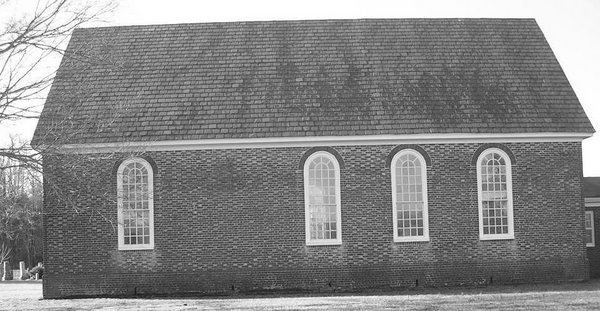
Upper Church, Stratton Major, King and Queen County N37.60285 W76.77049

This church, built between 1724-1729, has splendid brickwork in Flemish bond above the water table with glazed headers. The south doorway, in particular, with its square arches and triangular pediment is a wonder to ponder despite the jarring presence of modern storm doors. It is a rectangular church with dimensions of 64' x 33' 9' with 2' thick walls. It sits on the top of a small rise to the south of Route 14 which enhances its presence on a sunlight day. Reportedly there was an earlier church on the site whose presence was revealed by bulldozing possibly for the new west addition? Elaborate details of brickwork and the classical proportions of the building make it achieve the serenity few modern structures possess. I could almost feel the stares of 17th century parishioners as I walked around the building. Sadly, the west face is obscured by a new addition that crudely covers the magnificent pilasters and curved arch of the western entrance door. After the Revolution, the church was deserted and used intermittently by local congregations of Baptists and Methodists. It is now an active Methodist church with modern outbuildings and play apparatus. Modern maps refer to it as Old Church.