Showing posts with label Virginia. Show all posts

Saturday, October 25, 2008

St. Paul's Church, Norfolk Virginia

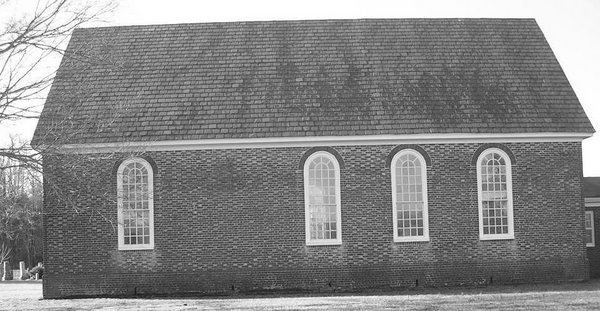
More correctly called the Borough Church of Norfolk, St. Paul's stands in the middle of a delightfully treed churchyard in downtown Norfolk. In fact, during most seasons, the church's original plan is difficult to discern due to later additions and the presence of trees that obscure the original church, making it especially troublesome to discover clear vistas for photographs. 
The parish has a rich and interesting history. It is third parish church of Elizabeth City Parish. A timeline is as follows:
  • 1636 New Norfolk County separated from Elizabeth City county
  • 1637 New Norfolk County divided into Lower Norfolk and Upper Norfolk Counties
  • 1640 Lower Norfolk Parish established
  • ? Lower Norfolk Parish sub-divided into Elizabeth River, Lynnhaven, and Southern Shore Parishes (Rawlings says "soon divided" (p. 153))
  • 1691 Lower Norfolk County split into Norfolk and Princess Anne Parishes
  • 1695 Lynnhaven and Princess Anne Counties merged
  • 1761 Portsmouth Parish and St. Bride's Parish split from Norfolk and Princess Anne
The original, cruciform church is laid in Flemish bond with glazed headers above and English bond below the water table. In the east transept, the chancel end, the water table is virtually at ground level while it seems to be about four bricks on the other walls with a beveled border throughout. The church is a large one: it is 86'6" east-west by 64'6" with walls approximately 30" thick. This original building is notable symmetrical, creating an almost perfect Latin cross (look on Google Earth to see this demonstrated.). The chancel is 18'6" long while each arm is 18'6" long. The nave is 33' wide wile each transept is 26'3" side. The nave itself is 42' long. Remember that Virginia's colonial churches took on the cruciform shape not due to its symbolism but rather to the need to seat more parishioners within earshot of the pulpit.

Friday, May 9, 2008

Bibliography

I have found a number of sources useful in my reading on these old buildings.

  • Meade, William. Old Churches, Ministers, and Families of Virginia. 1995 Philadelphia: Genealogical Publishing Co, Inc, 1847.

This is the basic reference available in two volumes as a reprint. I bought it off amazon.com. Bishop William Meade did an extensive physical survey of Virginia's colonial churches and recorded their condition in the early decades of the 19th Century. He exhaustively documents the parishes, families associated with parishes, the ministers, and anecdotes about the churches. He shows a clear evangelical bias and remonstrates against excesses of clergy and formal Anglican practices. Like Heroditus, he accepts many questionable stories, but to err on the side of completeness is not necessarily a historical sin. An invaluable resource.


  • Meade, George C. Colonial Churches of Tidewater Virginia. Richmond, Va.: Whittet and Shepperson, 1945.

George Meade complied this book after a long years of visiting sites and publishing articles in various periodicals. It is organized by counties and contains maps and some illustrations of the churches along with admirable summaries of parish and building histories. I purchased a used copy and found it was signed by the author. What a bonus!

  • Rawlings, James S. Virginia’s Colonial Churches: An Architectural Guide. Richmond, Va.: Garrett and Massie, 1963.

The canonical reference. Sporadically available on amazon.com. Organized by date of construction of each church with a succinct summary of parish history and lucid descriptions of the condition of each building's exterior and interior from the experienced eye of an architect. A must take on church jaunts. If you have to have one book about the churches, this is it. It contains a limited number of photographs of selected churches in color. He finds Merchant's Hope to be the stereotypical church, and it is hard not to agree with him.

  • Upton, Dell. Holy Things and Profane: Anglican Parish Churches in Colonial Virginia. New Haven and London: Yale University Press, 1986 (1997).

A brilliant book that examines not only the architecture but the social, historical, and cultural influence of these beautiful buildings. An absolutely must read. Upton brings to light aspects of colonial churches that are novel and transcending.

Thursday, March 27, 2008

Fork Church


Fork Church N37°51'12.81" W77°31'53.92” 1736-1740

Fork Church is a charming rectangular church located close to Richmond at the western end of Hanover County. To reach it go north on Route 1, paralleling I-95 to the west, and turn west on Routh 738 for a refreshingly bucolic trapse.

It is slightly larger than typical churches at 74’ x 34’ and has gorgeous brickwork noted by Rawlings (1063 142ff). The bricks are laid in Flemish bond with glazed headers throughout. A supremely ugly brick chimney is placed between the two chancel windows. The water table seems relatively high (I should have measured it.) and is laid in English bond. Beautifully toned rubbed brick marks the corners and the windows with some regularity. On the spring day we visited, the light brought out all the subtleties in those tones from deep red to rosy red. The windows themselves are in the form of beautifully proportioned segmental arches. The brickwork at the east and west end tops is obviously replaced; Rawlings hypothesizes this as evidence of original clipped gables (143).

The doorways have been altered by the addition of cumbersome, pillared porches with crude triangular roofs and equally clumsy decorative eaves (modillions) and matching half-columns (pilasters) on the walls. The columns are made of white painted brick and taper from bottom to top (classical entasis). Rawlings dreams fruitlessly of the restoration of the original doorways in his 1963 text (144).

For lovers of intricate window frames, this is Elysium. Rawlings describes them in some detail on page 144. I should have thought to take close-up pictures of them. Maybe next time.

The pews are largely original but substantially altered in height from a 1930 remodeling while the pulpit was moved from the north to east to north again. The oak floors are very likely original; this church never had the common flagstone floors typical of most colonial churches. There is a west gallery that is original along with an organ from the mid nineteenth century (Rawlings 145).

There is a large marble font from Mattaponi Church in King and Queen County, but no parish silver as it was destroyed in a 1936 fire.

The churchyard has many internments but none of colonial times and has the strangest, most clumsy wall around some of the older graves. It was erected from the east end of the church ten or so feet from the chancel wall and runs in a thin rectangle for a hundred feet or so. The brickwork in the wall is sloppy and irregular as is the wall capping. The graveyard, though, is worth a good hour of exploration.

Dolley Madison and Patrick Henry along with the novelist Thomas Nelson Page at least occasionally attended here and the actress Katherine Hepburn’s grandfather, S. S. Hepburn, was rector from 1893 to 1903.

All in all, Fork Church is a charming edifice with admirable brickwork. As a editing experiment, the first image shows the east edifice without the chimney.

Monday, November 26, 2007

Aquia Church


39 27' x 77 24': This church is located just off Route 95 and US Route 1 in Stafford Virginia. It is one of the easiest churches to find as the interstate exit, accessible from north or south, is labelled Aquia Harbor. The church is immediately north-east of the first light off the exit from 95.

This is truly a splendid building. According to Rawlings (184ff), the brickwork dates from 1751 to 1757 and was destroyed by Union soldiers during the Civil War. The walls as well as the interior have been rebuilt to the pre-Revolutionary War state sometime around 1915-16. Large patches of the walls are obviously rebuilt, in some cases carelessly even to my non-architect's eye. Apparently there was a coat of yellow paint on the building as recently as 1933.

Aquia is a true cruciform church with the walls 64' both east-west and north-south. Each arm is approximately 16' 2 1/2" long with a width of 32' 4". The walls are 24 1.2 " thick. Unlike Abingdon or Lancaster Churches, while in the interior, one can clearly see the cruciform structure, probably due to its Greek Cross construction. Like few colonial edifices, it has two levels of windows with the lower ones being rectangular with a keystone and angled soldiers and the upper being of typical compass construction. The front, west facade is two stories with a tower with a complicated cornice (See Rawlings 190).

It is surrounded by an attractive churchyard with many curious graves of colonial and modern origin.

In a later posting, I will describe the interior and many lurid stories surrounding the church.

This is a must visit.

Sunday, July 15, 2007

Westover Parish Church


N37.33120 W77.15853 1731 Erected 1731

This rectangular church, like most, is not the first near the site but the exterior in general remains in a state of remarkable preservation. It is located a half-mile or so to the east of Route 5t in a grove of trees beyond a brick and iron gateway. A colonial cemetery surrounds the church and the later, but matching, rectory buildings within the churchyard.

The parish itself is one of the oldest in America, dating from the mid 1620s and, in the early days, encompassed the land on both sides of the river until the establishment of parishes on the other side of the river. Most likely the present edifice was moved after permanent churches were built in surrounding areas.

The walls are laid in Flemish bond with glazing on all sides with a two-row layer of English bond in the very shallow water table whose top row is beveled. It is of average size – 60’ x 28’ and has clipped gables with a cedar shake roof as most churches originally did. There is rubbed brick at all four corners and around the windows. The west doorway was repaired in 1956 and is obviously of new brick while the arches above the windows were repointed in rowlocks that do not match the colonial brick. Rawlings considers the rubbed brick throughout the structure similar to that of Bruton Parish Church (1964 117). Queen closers are used are corners and windows. The window above the west door is inserted on what looks like a larger window (to my untrained eye), but the greatest changes are on the east façade that seems to have three openings but at present only one narrow window that is not at all colonial character.

The greatest changes are in the interior that is still one large room with a gallery on the west end and low slip pews with doors that are a post Civil War alteration due to Yankee destruction of the interior. In 1867 the east end was altered to make a deep chancel with small vestry rooms on each side of it. The Ten Commandments are posted to the side of the narrow window with a communion table and an altar rail before it. On the north side of the chancel end is a stone baptismal font; the pulpit, more correctly a rostrum, is on the south side.

I wonder about the windows. Rawlings does not mention them, but the mullions, particularly the y-tracery elements at the top do not seem colonial. He also mentions the lack of clipped gables, so the roof was redone after 1963? One element of the roof’s restoration that seems curious to my eye is the height of the windows. They are so high as to actually touch the eaves that are decorated with a dental molding that seems quite new. Did the parish lower the eaves with the clipped gables were restored?

All in all, this a pleasant edifice in an equally pleasant setting and well worth a hour or two visit; be sure to examine the graveyard as well as the church.

Sunday, June 3, 2007

Newport Parish Church


Newport Parish Church N36.94033 W76.58492 1682 (1632?)


Newport Parish church, locally called St. Luke’s Church or the Old Brick Church, is an architectural oddity and undoubtedly the oldest Gothic structure and the oldest Anglican church in the United States. The date of erection is a matter of debate between academics and local tradition and will be covered in another entry.

The basic building structure contains in full blown form the essential elements indigenous Virginia church architecture:

  • Orientation
  • West main entry door
  • Flemish bond and English bond
  • Water table
  • South vestry entry door
  • Rectangular, room-church plan.
  • Decorated west pediment

As well as several unique or seldom seen features of architecture that link it structurally to Yeocomico and St. Peter’s Churches:

  • Flemish / crow stepped gables
  • Covered west entranceway
  • Buttresses
  • Large, arched east window

And features surviving only in this building:

  • Y-tracery windows
  • Integral bell tower
The basic church is 60’6” x 24’3”, basically the standard size of the average Virginia liturgical edifice. The brickwork is 3’ thick at the foundation and 26” thick in the walls. There are three buttresses on the north and south walls with a Gothic shaped window located between each one. The water table is unique: I didn’t measure the height, but there are two of them instead of one – each about 2 1/2 feet high (?). There are numerous repairs to the brickwork on the walls, and there seems to be mixed bond: We noted basically Flemish bond with English bond on the buttresses, although there seem to be patches of mixed brickwork. Features such as the gables and windows show evidence of repointings at a number of locations. The gables have eight steps and superficially resemble those at Bacon’s Castle. The repairs and alterations are not surprising as the church was abandoned after the Revolution and the roof is reported to have collapsed during a thunder storm in 1887, revealing a dated brick.

The bell tower stands on the west wall, is three stories high, and was built as an integral part of the church. Its dimensions are 18’ east-west by 20’ north-south. There is a round, brick arch under a simple triangular pediment as the western entranceway leading to a replica of Yeocomico’s wicket door as the church’s entrance. The pediment over the arch is articulated by raised brick decoration and the interior of the triangle is filled with flat white plaster. On the north and south sides are oval openings three feet wide (I didn’t measure). The corners of the tower are decorated with brick quoins and between the two stories are a horizontal row of brickwork dividing them. Note that the quoins are smaller on the third story. There are green, shuttered windows on the outfacing windows and a triangular cornice surmounted by a weather vane.

Tuesday, May 29, 2007

Cattail Church


N37.75761 W77.13587 1751

Cattail Church, what is left of it, is in King William County at the end of a country lane in a suburban looking neighborhood. When we first saw it, we thought it was a nineteenth century church as the brick was overlaid with a thick layer of stucco, steeples with bizarre spikes have been added, the original rectangular room-church was shortened, and an addition was erected at the eastern end of the edifice. The buttresses, reminiscent of St. Luke's in Smithfield are a non-original addition. On close inspection, the bevel of the water table can be identified; all else, including the window frames, is substantially altered. As reported by Rawlings in 1963, several benches may be original (he cites four of them), and, indeed, Tom and I saw what seemed to be an old bench left out in the open portico east of the church that seemed to have been left there for some time.

Its original dimensions were most likely 60' x 30'; the more or less standard size for rectangular room churches. There is little for the student of colonial churches here. Note the curious quoins on the north steeple opposite the triangular cap for the southern one. In Rawlings' account, he mentions that the steeples are painted green although they are now silver. Cousin Tom mentions that European steeples are invariably green. Does anyone have documentation or a raison d'etre for green steeples?

The surrounding graveyard, begun by a local Black Baptist congregation, has numerous internments and curious features such as grave slabs and concrete crosses on many of the graves. Rawlings calls the church ". . . curious and lamentable" (184) while Upton has eliminated it from architectural analysis completely.

Sunday, May 13, 2007

Vauter's Church


Vauter's Church (Vawter's) 1719-1731 N38.08642 W77.06798

This delightful building lies just to the north of Route 17 in Essex County between Port Royal and Tappahannock. There are several interesting features of the structure, so I will post different blogs about the exterior, the interior, and the stories about the church.

Vauter's Church is a T-shaped building with the offset to the south -- the best preserved church of its type in the USA. It is the fourth (?) building of St. Anne's Parish and the first brick church of the parish. St. Anne's Parish was founded circa 1704-1711. Rawlings and Upton both consider this church as a modified one with the basic rectangular structure erected around 1719 and the southern T erected in 1731 according to the dating brick. The present rector, Dr. Agnew, states from his examination of the rafters on a crawl though them that the structure was originally erected as a T-shaped structure in 1731?

In any case, the location of the church on a small knoll surrounded by picturesque trees and a small graveyard, makes this the most pleasing site I have visited so far. The rectangular east-west structure is 56'6" x 30'2" -- of average size -- while the T-wing is 30'2' wide by 16' long. The T of the chancel is 10'3" wide. Rawlings cites the irregular placement of the southwest windows so that the shutters overlap and irregular flagstones in the aisles as evidence of later construction of the south wing. I, sadly, didn't think to examine them. The walls are 2' thick.

The walls are in superb shape with the checkering of the glazed brick particularly noticeable. The water table is beveled with the expected English bond below and Flemish bond above. A small number of glazed headers are used in the water table itself. Along the angled rafters of the roof (barge boards) is a row of glazed headers as, to a disorganized extent, in Yeocomico and, in a similar manner, in St. John's, King William. Rubbed brick is present in doorways and window jambs, and there is as well fairly consistent use of queen closers in doorways and windows.

The doors themselves are possibly the oldest ones in the state; an interesting feature of the south doors is that they seem to have been put on backwards -- the door panels are concave instead of convex and the weathering on them suggests that they were always that way. the size and spacing of the arches shows great craftmanship. The south door has a triangular pediment while the west door has a semicircular arch as seems typical in these Northern Peninsula churches compared to those south of the James. The pilasters also show great evidence of symmetry and master brickwork.

The windows have circular (compassed) arches with some replacements in the arches. The west facade has two small windows for the balcony that are square with semicircular arches. The roof appears at first to have a consistent angle but is actually kicked gently at the eves, giving it a graceful look.

All in all, this church is beautifully preserved in an idyllic setting and a must visit. It is still an active congregation, and while, we were there, a tour bus arrived, and we were invited by the genial pastor and visitors to tag along with them.

The

Mangohick Church


Mangohick Church 1730-32 N37.80782 W77.27191
This greatly modified church is located some twenty miles northeast of Richmond on Route 30 in King William County to the south of the roadway in a large, grassy area with mature cedar and hardwood trees. The name Mangohick is reputed to be of Native American origin as is as well the name of a nearby creek.

The original building was of average size, 61' x 28' and is of typical bonds: English bond below the water table and Flemish bond with glazed headers above it. There are several bricks with initials, some modern and some of possible colonial origin: particularly over the south doorway with the date 1731 and the initials WV? The water table is characterized by a beveled edge where it meets the walls, and there are ventilation holes still present in the lower courses. The south door frame shows the effect of a clumsy restoration as do several of the windows and sections of brick about the structure, most notably the north wall. The west doorway was likely originally a segmental arch but is now a flat one with voussoirs and, as the south door, a recent set of doors.

Added to the east wall is a completely new structure that obscures the brickwork almost entirely. There is a one small window asymmetrically placed on the north wall that is, I believe?, behind the original pulpit. The dental molding at the roof is considered to be original, and the glazed brick is of considerable interest -- a closeup of a glazed brick is included in the illustrations.


The church was abandoned after the Disestablishment and taken over by a local Black Baptist congregation that still uses it to this day. It is again pleasing to see an ancient edifice still in use.

Sunday, April 29, 2007

Lamb's Creek Church


Lambs Creek Church N38.26366 W77.26908 1769-1770

This church is unusual in dimensions, reflecting a change in church architecture in the shape and organization of the building. It is a huge structure, 79'11" x 33'11', approaching the 80 foot limit of audibility in a structure.(Upton, 1985). Tellingly, the pulpit was located on the north wall opposite the south door, thus in the center of the church. In general perspective, the building resembles the meeting house of the northern colonies. It is likely that the south doorway was the main entrance (Rawlings, 1963).

The brick is laid in Flemish bond both below and beyond the beveled water table. The walls themselves show little evidence of repair outside minor repointings and repairs. There is the usual use of rubbed brick in corners and doorways along with queen closers at windows. Because of the length of the church, there are fourteen windows, all covered by ghastly, but most likely, needed metal screens. The wood trim on the north chancel window and the third from western north window are of old, possibly colonial, origin (Rawlings, 1963).

Both doorways are marked by triangular pediments and raised brick pilasters with rectangular wooden doors of later origin. The date, 1770, is prominently incised on the western doorway.

Opposite the western doorway is a boulder with the name and date of erection of the church inscribed on it. The setting, near several houses, and characterized by rank grass diminishes the presence of the building which is set on a small rise near a crossroads just off Route 3 east of Fredericksburg.