Showing posts with label t-shaped. Show all posts

Saturday, June 7, 2008

Dimensions of Yeocomico Church


I have altered the chart of dimensions of Yeocomico Church as a table. Note the curious variability of the walls.

Sunday, May 13, 2007

Vauter's Church


Vauter's Church (Vawter's) 1719-1731 N38.08642 W77.06798

This delightful building lies just to the north of Route 17 in Essex County between Port Royal and Tappahannock. There are several interesting features of the structure, so I will post different blogs about the exterior, the interior, and the stories about the church.

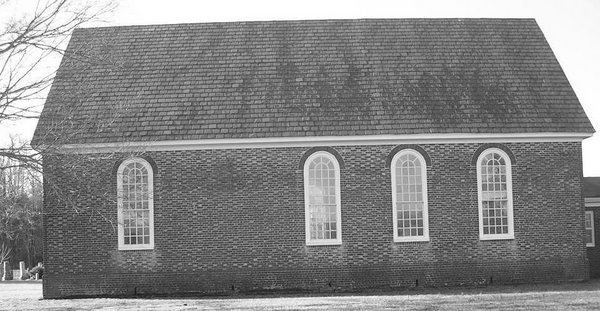
Vauter's Church is a T-shaped building with the offset to the south -- the best preserved church of its type in the USA. It is the fourth (?) building of St. Anne's Parish and the first brick church of the parish. St. Anne's Parish was founded circa 1704-1711. Rawlings and Upton both consider this church as a modified one with the basic rectangular structure erected around 1719 and the southern T erected in 1731 according to the dating brick. The present rector, Dr. Agnew, states from his examination of the rafters on a crawl though them that the structure was originally erected as a T-shaped structure in 1731?

In any case, the location of the church on a small knoll surrounded by picturesque trees and a small graveyard, makes this the most pleasing site I have visited so far. The rectangular east-west structure is 56'6" x 30'2" -- of average size -- while the T-wing is 30'2' wide by 16' long. The T of the chancel is 10'3" wide. Rawlings cites the irregular placement of the southwest windows so that the shutters overlap and irregular flagstones in the aisles as evidence of later construction of the south wing. I, sadly, didn't think to examine them. The walls are 2' thick.

The walls are in superb shape with the checkering of the glazed brick particularly noticeable. The water table is beveled with the expected English bond below and Flemish bond above. A small number of glazed headers are used in the water table itself. Along the angled rafters of the roof (barge boards) is a row of glazed headers as, to a disorganized extent, in Yeocomico and, in a similar manner, in St. John's, King William. Rubbed brick is present in doorways and window jambs, and there is as well fairly consistent use of queen closers in doorways and windows.

The doors themselves are possibly the oldest ones in the state; an interesting feature of the south doors is that they seem to have been put on backwards -- the door panels are concave instead of convex and the weathering on them suggests that they were always that way. the size and spacing of the arches shows great craftmanship. The south door has a triangular pediment while the west door has a semicircular arch as seems typical in these Northern Peninsula churches compared to those south of the James. The pilasters also show great evidence of symmetry and master brickwork.

The windows have circular (compassed) arches with some replacements in the arches. The west facade has two small windows for the balcony that are square with semicircular arches. The roof appears at first to have a consistent angle but is actually kicked gently at the eves, giving it a graceful look.

All in all, this church is beautifully preserved in an idyllic setting and a must visit. It is still an active congregation, and while, we were there, a tour bus arrived, and we were invited by the genial pastor and visitors to tag along with them.

The

Friday, March 23, 2007

St John's King William


St John's, King William County1734 N37.61616 W76.92078

The next church cousin Tom and I visited on March 17 is St John's, King William County. It is a rare, T-shaped church with the chancel (altar) on the east and a projecting wing to the north. The north and west doorways are stunning. The north has a triangular pediment with brick column pilasters while the west has a semicircular pediment with identical pilasters. They seem identical in style to those of Stratton Major and St Stephen's we stopped at earlier in the day. According to my reading, the T-shaped and cruciform churches were not designed as a architectural feature symbolizing crosses but rather as a means to enlarge the church economically as well as to provide adequate volume for the parishioners as a rectangular church has a audible limit of 80 feet maximum. The north wing was most likely built circa 1755. The walls are cited as being in poor repair in a 1963 source (Rawlings, James S. Virginia's Colonial Churches: An Artchitectural Guide. Richmond: Garrett and Massie, 1963 -- the canonical reference source) but now seem in good repair. The windows are correct 18th century form with compass (semicircular) tops and, like the doorways and corners, have rubbed brick, made by selecting light colored bricks and literally rubbing them to give them a different pattern. These subtle touches make the buildings all the more interesting to look at. There is a modern rest room building and a kiosk with the church's history well documented that is part of a modern restoration that is itself stunning. The inside is completely restored to the 1755 condition with the correct display of the Lord's Prayer, The Ten Commandments, and the Apostles' Creed in large tablets above the communion table. I wish I had space for all that this church offers. It is available for weddings, etc., at a very reasonable rate. Quixotically, my camera ran out of battery power just as we arrived, to only two pictures are available. I must make another trip and soon. http://www.stjohnswp.org/oldstjohns/ is the church foundation's site. I highly recommend it for more detailed information.

Tuesday, March 20, 2007

Yeocomico Church


Yecomico Church N38.06231 W76.59685

This church is an oddity. Built in 1706, it shows a transition from Gothic churches like St. Peter's (below) and St Luke's in Smithfield (Newport Parish). The two earlier churches (1701 and 1680s) have clear Gothic features like buttresses, Flemish or crow-step gables, and casement windows with small diamond panes. (St Luke's original windows were apparently Gothic Y-tracery ones with clear glass panes -- not the stained glass presently in place.)

Yeocomico is a small church, 51' x 26'-27' (different widths at west and east ends). It may have been built as a rectangular church (like St John's, King William County) and later changed to its present T-shape. It has a unique porch on the south with the only wicket door from colonial times (It is reputed to weigh over 1,000 pounds.). There are irregular variations in the brick bond throughout the walls made of bricks, according to the nearby monument, fired in a kiln on the site. The windows are covered by heavy green, wooden, rectangular, rustic shutters (We could not get in the church as no one was on site to open the church for us.) . There are three doors: two on the south and one on the north. The two south doors are marked by fantastic pilasters while the rest of the church has several brick plaques with the initials of the builders, a thistle, and Masonic (?) symbols. It is a small church that just oozes charm: all the more so because it is completely surrounded by a restored churchyard wall containing stately trees. I will visit again and give a more complete report as this site deserves it. is the church foundaton's site: I recommend it for more detailed information. Check http://fredericksburg.com/News/FLS/2006/092006/09302006/225092