Showing posts with label King William County. Show all posts

Tuesday, May 6, 2008

St John's, King William County Reredos


Some time ago, I found this early Twentieth Century image of the reredos replaced in the recent renovation. Rawlings hypothesizes it was taken from a nearby church, probably Stratton Major.

Tuesday, May 29, 2007

Cattail Church


N37.75761 W77.13587 1751

Cattail Church, what is left of it, is in King William County at the end of a country lane in a suburban looking neighborhood. When we first saw it, we thought it was a nineteenth century church as the brick was overlaid with a thick layer of stucco, steeples with bizarre spikes have been added, the original rectangular room-church was shortened, and an addition was erected at the eastern end of the edifice. The buttresses, reminiscent of St. Luke's in Smithfield are a non-original addition. On close inspection, the bevel of the water table can be identified; all else, including the window frames, is substantially altered. As reported by Rawlings in 1963, several benches may be original (he cites four of them), and, indeed, Tom and I saw what seemed to be an old bench left out in the open portico east of the church that seemed to have been left there for some time.

Its original dimensions were most likely 60' x 30'; the more or less standard size for rectangular room churches. There is little for the student of colonial churches here. Note the curious quoins on the north steeple opposite the triangular cap for the southern one. In Rawlings' account, he mentions that the steeples are painted green although they are now silver. Cousin Tom mentions that European steeples are invariably green. Does anyone have documentation or a raison d'etre for green steeples?

The surrounding graveyard, begun by a local Black Baptist congregation, has numerous internments and curious features such as grave slabs and concrete crosses on many of the graves. Rawlings calls the church ". . . curious and lamentable" (184) while Upton has eliminated it from architectural analysis completely.

Sunday, May 13, 2007

Mangohick Church


Mangohick Church 1730-32 N37.80782 W77.27191
This greatly modified church is located some twenty miles northeast of Richmond on Route 30 in King William County to the south of the roadway in a large, grassy area with mature cedar and hardwood trees. The name Mangohick is reputed to be of Native American origin as is as well the name of a nearby creek.

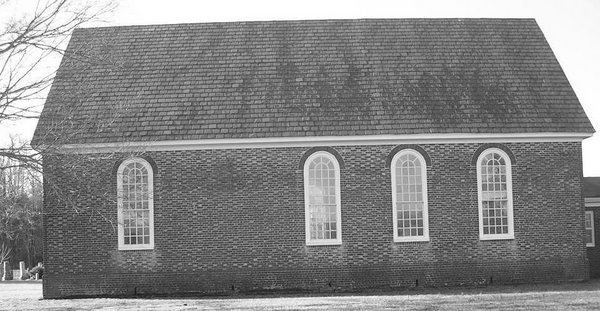
The original building was of average size, 61' x 28' and is of typical bonds: English bond below the water table and Flemish bond with glazed headers above it. There are several bricks with initials, some modern and some of possible colonial origin: particularly over the south doorway with the date 1731 and the initials WV? The water table is characterized by a beveled edge where it meets the walls, and there are ventilation holes still present in the lower courses. The south door frame shows the effect of a clumsy restoration as do several of the windows and sections of brick about the structure, most notably the north wall. The west doorway was likely originally a segmental arch but is now a flat one with voussoirs and, as the south door, a recent set of doors.

Added to the east wall is a completely new structure that obscures the brickwork almost entirely. There is a one small window asymmetrically placed on the north wall that is, I believe?, behind the original pulpit. The dental molding at the roof is considered to be original, and the glazed brick is of considerable interest -- a closeup of a glazed brick is included in the illustrations.


The church was abandoned after the Disestablishment and taken over by a local Black Baptist congregation that still uses it to this day. It is again pleasing to see an ancient edifice still in use.

Friday, March 23, 2007

St John's King William


St John's, King William County1734 N37.61616 W76.92078

The next church cousin Tom and I visited on March 17 is St John's, King William County. It is a rare, T-shaped church with the chancel (altar) on the east and a projecting wing to the north. The north and west doorways are stunning. The north has a triangular pediment with brick column pilasters while the west has a semicircular pediment with identical pilasters. They seem identical in style to those of Stratton Major and St Stephen's we stopped at earlier in the day. According to my reading, the T-shaped and cruciform churches were not designed as a architectural feature symbolizing crosses but rather as a means to enlarge the church economically as well as to provide adequate volume for the parishioners as a rectangular church has a audible limit of 80 feet maximum. The north wing was most likely built circa 1755. The walls are cited as being in poor repair in a 1963 source (Rawlings, James S. Virginia's Colonial Churches: An Artchitectural Guide. Richmond: Garrett and Massie, 1963 -- the canonical reference source) but now seem in good repair. The windows are correct 18th century form with compass (semicircular) tops and, like the doorways and corners, have rubbed brick, made by selecting light colored bricks and literally rubbing them to give them a different pattern. These subtle touches make the buildings all the more interesting to look at. There is a modern rest room building and a kiosk with the church's history well documented that is part of a modern restoration that is itself stunning. The inside is completely restored to the 1755 condition with the correct display of the Lord's Prayer, The Ten Commandments, and the Apostles' Creed in large tablets above the communion table. I wish I had space for all that this church offers. It is available for weddings, etc., at a very reasonable rate. Quixotically, my camera ran out of battery power just as we arrived, to only two pictures are available. I must make another trip and soon. http://www.stjohnswp.org/oldstjohns/ is the church foundation's site. I highly recommend it for more detailed information.