Showing posts with label Lancaster County. Show all posts

Saturday, April 28, 2007

St Mary's Whitechapel


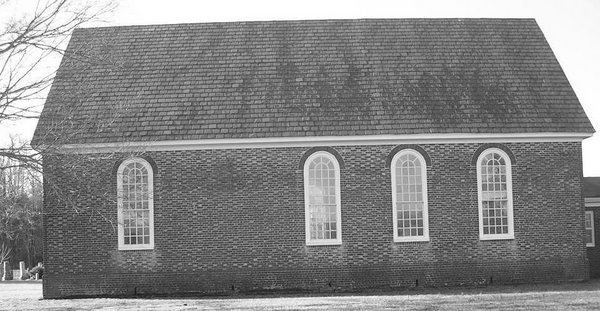
St Mary's Whitechapel N37.74731 W76.55239 1740-1741

This church is presently a rectangular structure that has endured transitions from its first erection: in 1669 it was erected as a rectangular edifice, transepts were added in 1740 to make it a cruciform church, and in 1832 all but the nave and chancel were demolished. Thus the present church bears little relation in its structure to either church, and it is hard to see, while visiting the site, the exact relationship of the present edifice to the original church. Tom and I had to walk around the site several times and consult the kiosk before we could picture the site of the original church. This isn't helped by the ungainly south porch that is an ill match to the building both in its proportions and details. To view the dimensions of the original church, it is necessary to stand in the set of hedges where the chancel used to stand and mentally rotate the cruciform structure.

The brickwork is in Flemish bond with glazed headers and English bond below the beveled water table. There is evidence of numerous repairs and alterations to the walls. Windows on the ends and the north wall are believed to be original. They are compass framed with semi-circular arches. The southernmost window on the east wall is said to be original by Rawlings (1963, p. 164) while the north windows have original sills (Ibid).

We were unable to get to the interior as the building was locked, but the most appealing attributes are an ancient baptismal font (1718) and a set of chancel tablets bearing the Ten Commandments, the Lord's Prayer, and the Apostle's Creed dating from 1702 and 1718. The chalice, paten, and other silver are from 1669 along with Wicomico's silver from
1711 to 1729 are also part of the parish's interior appointments. Characteristically, the panels and silver from this parish are prominently inscribed with the donating family, the Foxs, reminding me of the essential hubris of Lancaster Church.

This is still an active church with a tasteful set of parish buildings across the parking lot from the church and extensive graveyard.

Saturday, April 21, 2007

Christ Church, Lancaster


Christ Church, Lancaster County N37.68173 W76.42296 1728-1732This church is a truly impressive and well-preserved edifice. There is an excellent web site by a preservation organization, so I won’t include all of the data here but just my general impressions.Robert Carter, the immensely wealthy and powerful owner of Cortoman Plantation, directed in his will that funds be used to build a church, and it is worthy of the legendary “King Carter’s” status. The first impression upon approaching the edifice is its sheer size. Although it is not the longest church in the state (that honor I believes goes to Bruton Parish’s 100 foot nave) the Latinate cross-shaped building has walls that are some 33’ high – much higher than that of any other colonial church. According to Rawlings, the cross measures 70’ x 70’, but is longer east to west than north to south, so that it appears to be a Greek cross when viewed close up. The massive roof raises the total height to at least 43’ high. Walking up to it is like viewing a pyramid. The walls are in Flemish bond with random glazed bricks and include elements such as sandstone keystones to the windows and doors. The walls are reportedly 36” thick.
The doors themselves are elaborate and massive. The most awe-inspiring is the west doorway that is 21’ high and has an even larger, intricate pediment. A picture alone can not do it justice. The doors on the north and south transepts are equally as impressive.The Carter tombs on the east side of the church are of marble and feature elaborate carvings of colonial motif cherubs and death heads.
I won’t even touch the inside of the church until I make a visit later this year.The general impression this edifice gives me is one of hubris: Carter meant not only to show faith, if he meant to show it at all, but rather to render his exalted position in the colony. It fits such detail in other churches as conspicuously exhibiting a patron’s name or initials on such donatives as wall plaques or communion silver. Dell Upton calls the rising Virginia a “proud and unlovely people.” It aptly describes the tone of the church. Shelley also wrote about this idea in “Ozymandias” – “Look upon my works, Ye mighty, and despair!” Read the poem for an apt conclusion.Extensive information from the Foundation for Historic Christ Church is available at http://www.christchurch1735.org/.