Showing posts with label Christ Church. Show all posts

Saturday, April 21, 2007

Christ Church, Lancaster


Christ Church, Lancaster County N37.68173 W76.42296 1728-1732This church is a truly impressive and well-preserved edifice. There is an excellent web site by a preservation organization, so I won’t include all of the data here but just my general impressions.Robert Carter, the immensely wealthy and powerful owner of Cortoman Plantation, directed in his will that funds be used to build a church, and it is worthy of the legendary “King Carter’s” status. The first impression upon approaching the edifice is its sheer size. Although it is not the longest church in the state (that honor I believes goes to Bruton Parish’s 100 foot nave) the Latinate cross-shaped building has walls that are some 33’ high – much higher than that of any other colonial church. According to Rawlings, the cross measures 70’ x 70’, but is longer east to west than north to south, so that it appears to be a Greek cross when viewed close up. The massive roof raises the total height to at least 43’ high. Walking up to it is like viewing a pyramid. The walls are in Flemish bond with random glazed bricks and include elements such as sandstone keystones to the windows and doors. The walls are reportedly 36” thick.
The doors themselves are elaborate and massive. The most awe-inspiring is the west doorway that is 21’ high and has an even larger, intricate pediment. A picture alone can not do it justice. The doors on the north and south transepts are equally as impressive.The Carter tombs on the east side of the church are of marble and feature elaborate carvings of colonial motif cherubs and death heads.
I won’t even touch the inside of the church until I make a visit later this year.The general impression this edifice gives me is one of hubris: Carter meant not only to show faith, if he meant to show it at all, but rather to render his exalted position in the colony. It fits such detail in other churches as conspicuously exhibiting a patron’s name or initials on such donatives as wall plaques or communion silver. Dell Upton calls the rising Virginia a “proud and unlovely people.” It aptly describes the tone of the church. Shelley also wrote about this idea in “Ozymandias” – “Look upon my works, Ye mighty, and despair!” Read the poem for an apt conclusion.Extensive information from the Foundation for Historic Christ Church is available at http://www.christchurch1735.org/.

Christ Church, Middlesex


Upper Church Middlesex (Christ Church Middlesex) N37.60474 W76.53437 1714

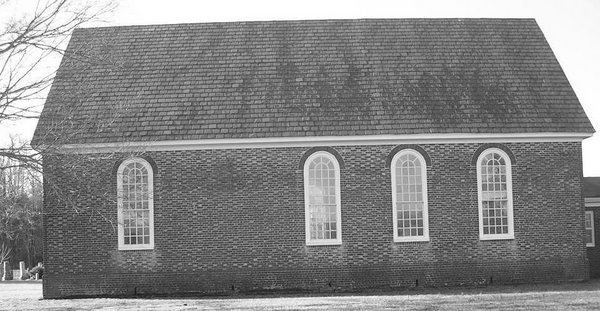
This rectangular church is average size 60'x331/2' and is laid in Flemish bond (even the water table). It has the typical features of orientation, glazed brick, compass windows, west entrance, and originally a south vestry door (now converted to a small compass window). There is the usual presence of queen closers and rubbed brick at the corners and in the window jambs.

The water table has has a convex curve (ovolo) that gives it an interesting look. The west and south walls have glazed brick in the headers while the north and east walls lack this feature. According to Dell Upton, this indicates not a lack of workmanship on the part of the builder, but the idea that the building was expected to be viewed from the south and west as parishioners entered for services.

On the east, or chancel, end the original large window was replaced by a smaller compass window, but the outline of the earlier, large chancel window is clearly evident. Upton asserts that this is an intermediate form derived from the Y-tracery windows present in seventeenth century churches such as Newport Parish and cites building requests for a large windows in both this church and Lower Middlesex Church. Later churches had compass or rectangular windows in the chancel that generally matched the general size and shape of the south and north windows (in both extant and destroyed churches). This original chancel window was ten feet high and most likely matched the size and shape of St. Peters -- a large, compass-headed one filling a large portion of the east facade. The side windows on the south and north show evidence of extensive relocation and shortening, to me ruining the classical stasis of the facades.

The original doorways are gone, replaced in the west by a brick entry at the east end and a jarringly small window on the south east end. Worse is the presence of additions on the north end that, like the entry, have clearly modern brick with exaggerated dark bricks and modern finish and size that contrasts strongly with the colonial brickwork. The interior, too, is changed beyond recognition as a colonial structure. Next to the church is a private Episcopal school with modern tin-buildings that diminishes the setting.