Showing posts with label room church. Show all posts

Thursday, July 3, 2008

Little Fork Church

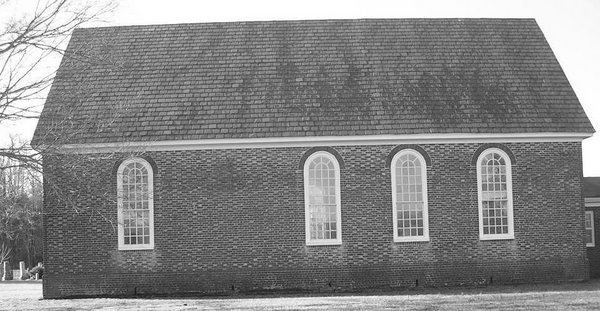
Sometimes, expectations are less than reality. I presumed this church would resemble the overall setting of Lamb's Creek Church, and it does structurally, but the superb restoration and pastoral churchyard of Little Fork Church result in a total greater than the sum of its parts. This large (83 1/2' x 33 1/2') edifice stands on a small rise of ground off of Route 229 between Culpeper and Warrenton, Virginia that retains true colonial charm like few churches in the state.

It is considered to be a transitional church of late construction, begun in 1773 and completed in 1776, having characteristics of a rectangular church combined with the contemporary, two story churches of Northern Virginia in a geographic swath from Falls Church to St. Paul's, King George County. It retains elements such as orientation, south and west doorways, compass windows, and Flemish bond, yet includes elements such as a deep church configuration, a hipped roof, movement of southern door to the center of the southern wall, classical door pediments, and a pulpit on the northern wall opposite the southern doorway. It lacks elements of deep churches in Northern Virginia such as two tiered windows and cruciform structure.


Unlike most colonial churches, the designer and builder, John Ariss (circa 1725-1799) is known and designed another similar church Lamb's Creek Church that is s twin of this building. It replaces a wooden church built on or near the same site that burned to the ground in 1773. Instead of another wooden church, apparently planned by Edmund Bass who was paid five pounds for his work, this brick edifice was erected. The church site brochure cites William Phillips as the builder (for a fee of 35,000 pounds) and John Voss as the designer.

It derives its name from the junction of the Hazel and Rappahannock Rivers that are nearby. The name recorded on some plats like the USGS topographical maps of Oak Shade Church has no validity.


The bricks are laid in Flemish bond both in the water table and the walls and show occasional use of glazed brick in both headers and stretchers. The walls are 22" thick. Queen closers and rubbed brick are present at the corners, compass windows, and doorways. The transition from the water table to the walls is via an ovolo, or convex, molded brick. It is a large, deep church as already stated, approaching the limit of audibility in its 83 foot length. The modillion cornice, large toothed decorated eaves, are probably of colonial origin.

The interior, destroyed during the Civil War for Union Cavalry firewood, was restored in 1871 and 1976. The last restoration was done under the supervision of William Griggs, a noted historical architect, and is a painstakingly accurate restoration of the original interior. It consists of box pews painted colonial blue-green with dark wood tops, the original reredos on the eastern wall, and a reader's lectern under the "wine-glass" pulpit high on the north-central wall, directly opposite the southern doorway. In 1963, Rawlings reports a plaster line indication that the original wainscoting was taller than that installed in the nineteenth century restoration. This is apparently corrected in the recent repairs. The elaborate reredos contains a central tablet bearing the Lord's Prayer, the Decalogue, and the Apostles' Creed in modern gold lettering on a black background. The cornice and cross are modern additions rather than colonial features. It is mentioned in the church website that the box pews were constructed to keep out winter drafts, and that parishioners used foot warmers during winters. The flat wooden ceiling is a restoration as are most of the floorboards; Rawlings believes the floor level was originally lower.

The windows are of typical compass style with round arches of voissiors, rubbed brick, and queen closers. They are 8' 8" tall. There are ten windows in all. Those on the south, east, and north are identical while those on the west wall are small rectangular openings with flat arches, characteristic of openings for galleries in other churches. There is no evidence for a western gallery in this church (as in its sister church, Lamb's Creek, that lacks the western windows entirely). The doorways are most likely not the original form: the church probably had classical pediments like Pohick Church or Lamb's Creek Church as evidenced by brick repairs surrounding the doors. The original door openings were approximately 6' 7" wide, and the southern entrance was probably the main one.

Historically, the building was used as a drill field for the Little Fork Rangers, Co. D, 4th Virginia Cavalry in 1861 and, as already mentioned, a stable for Union cavalry in 1863 when the interior was destroyed. A "contrite Union officer" reputedly sent $100 to the church after the war to replace the destroyed pews. A marble monument to the Little Fork Rangers stands south east of the church and an apparently modern sun dial is placed on a brick base in front of the southern approach. There are no colonial graves near the present church, although there seems to be the start of a contemporary memorial garden cemetery to the east of the building among a copse of small trees. Small cedar trees sporadically surround the church that is embellished by a beautifully kept lawn encircling it.

In summary, the church is placed in a charming setting and has been lovingly and accurately restored to reflect its colonial heritage. Rawlings, always the objective historian, reports: "Although as an architectural monument it is without a superior in . . . [nearby] counties . . . it is one of the two or three most neglected of our colonial churches. " The recent restoration seems to have corrected all of this, and like many other of these significant buildings, it is encouraging to see Little Fork Church not only correctly restored but in active use by a congregation. As a last impression, the brick work on this church is simple splendid; in the morning light, the various hues of the individual bricks, accentuated by the rubbed brick doorways, windows, and corners are indescribably captivating.


Sunday, May 18, 2008

Merchant's Hope New Images


I have added several images here referrring to the the previous post.

Merchant's Hope Revisited

Dating
The church has been dated by local tradition and a date carved on one of the roof trusses to 1657 (Rawlings 28), but recent historic and architectural evidence establish a date of approximately 1725 (Upton xv).

The church was primarily part of Martin’s Brandon Parish as both an upper and lower church. It is located on the Old River Road that preceded the present Route 10 that connects Suffolk with Hopewell. (Mason 79). The parish affiliation changed as parishes were reorganized during the colonial period. The record is somewhat confusing, and recent dating or 1725 by Upton tends to change the parish affiliation of this particular building dramatically:

1618: Martin’s Brandon Parish was originally a plantation parish named from a nearby plantation. It was united with Prince George’s Parish at that time (Rawlings 28).
There is indirect evidence of an active parish and, therefore some kind of church edifice, in 1665 and 1675 (Mason 78).
1655 – 1688 – 1720: Martin’s Brandon Parish was made independent of, absorbed by, and again made independent of Westover Parish, immediately north of the James River (Rawlings 28; Mason 78).
1655- 1688: The parish was referred to as Jordan’s Parish(Rawlings 28).
1688: Is mentioned as a chapel of ease for Westover (Rawlings 28).
1720: Is mentioned as the upper chapel of Martin’s Brandon Parish (Rawlings 28).

Name
The vernacular name Merchant’s Hope for the present church is derived from the nearby plantation of the same name. The linking of the church to a sailing bark called Merchant’s Hope has no validity. The ship and church derived their names from the plantation (Rawlings 27-8).

Architecture

Brickwork
This church is the outstanding example of the brick, rectangular room church in the state of Virginia.
It is 60’ x 25’ as measured on the inside. In colonial contracts for churches this was referred to as “in the clear.” It consists of 22 ½ inch thick walls of solid brick (two-and-a-half bricks thick) with English bond below the water table five bricks high and Flemish bond above the water table. The transition from the water table to the walls contains a row of beveled bricks. Glazed headers are used throughout the building, and there is a row or glazed headers along the barge boards. Unlike most churches of the early eighteenth century, there is almost no serious reconstruction in the walls. Queen closers of rubbed brick are present in the doorways, the window trim, and at all four corners of the building (Mason 78; Rawlings 28).

Doors
The main entrance, west door, pediment, is of the most simple character; it consists of a compass heading with simple wood panels on the doors which may be of colonial manufacture. The brickwork surrounding the door is an understated pediment with no pilasters, pillars embedded in a wall. Its only decoration consists of rubbed brick accentuated by queen closers and an arch of flat bricks. The door itself is embellished by a wooden lunette, here a half-circle, and its two, center-opening doors have a small horizontal panel over two large vertical panels. The door’s wooden trim contains curved cyma reversa, a reversed S-shaped molding, pieces separating three panes. Wooden pegs are used in both the doors and windows. H-L hinges are used throughout the building. (Mason 79; Rawlings 29).

The south door is identical in detail with the exception that it is a shorter, rectangular opening in the chancel end of the church with a flat arch at the top (Mason 79; Rawlings 29).
Upton comments that “the doorways were [sic] comparable in size and visual emphasis to the windows, rather than inconspicuous.” (70) and that all Virginia brick churches lacking an elaborate pediment have similar doors with a compass head in the west end and a flat head on the south wall (117).

Windows

Merchant’s Hope has the best preserved compass windows of surviving colonial churches and displays the eventual style of chancel windows universal in eighteenth century Virginia churches. Although they show systematic repairs, they are “very old” and “surely colonial” (Rawlings 29). They consist of identically sized windows on the north, east, and south walls. There are four windows on the north, two in the east, and three on the south (The vestry door is directly opposite the north-eastern window.). On the west wall above the door is a small compass window. The brick embellishment is the same as the west doorway with rubbed brick, queen closers, and a curved arch. They have two vertical sections made up of 24 over 16 panes. They are true guillotine windows with no counterweights. The wood work on the windows, like the west doorway, is a reverse S-curve, and the muntins are one inch thick. The bottoms consist of wooden sills with a row of beveled bricks below them in oarlock orientation. (Mason 79; Rawlings 29; Upton 71).

Interior
The interior was gutted during the Civil War when the church was reputedly used as a cavalry picket station, although there was no damage to the doors, windows, or gallery (Rawlings 30). It was reconstructed and now resembles the general room church configuration with the exception that the T-shaped aisle has been altered to an L-shaped one with the top of the L at the west door and the stem at the south. (Rawlings 29). The chancel has a communion rail instead of a rood screen as at Newport Parish and Yeocomico while the pews are similar to those of Vauter’s church, single row box pews with a door on each end. The pulpit is just south-west of the chancel although it was originally near the middle of the south wall (Rawlings 20). The west gallery still had an original stairway and rail (Rawlings 29) with asymmetrical balusters characteristic of the early eighteenth century (Upton 109). On the east wall is a communion table centered between the windows and tablets of obligatory scripts: from left to right, the Lord’s Prayer, the Ten Commandments (Exodus XX), and the Apostles’ Creed. Most notably lacking is the display of a cross: no Anglican Virginia church displayed a cross during the colonial period (Upton 118-121).

Floor
The floor reputedly contains original 18” square flagstones or Portland stone (Rawlings 29). According to rather dubious evidence, there is a crown mark on the underside of the tiles identifying them as having English origin (Brock 24). An architectural problem with the floor is that the present level is too low for the doorways. Either the door openings as well as the doors were larger or the floor was higher. The present structure of a high door step combined with a low floor is most unlikely to be of original origin (Rawlings 29-30).

Roof / Ceiling
The most prominent feature of the exterior roof is the pronounced kick of the eaves which flatten them, giving the entire church a distinctive look. (Mason 79; Rawlings 30). Of course, the present slate roof is not the original one. (Rawlings 30). The roof truss construction is of considerable interest since it is the earliest known example of a king-post truss that is bent at the feet to allow a curved ceiling (see Upton p 44 Fig 24 for a diagram of the elaborate roof trusses.). The present surface is a semi-domed plaster ceiling completely concealing the truss structure (Upton 43-44). It was common for ceilings to be painted blue with clouds though this in not mentioned in regards to Merchant’s Hope (Upton 3).

Symbolism and Structure
This church contains the most pure example of the essential elements of a rectangular room church (Upton 60-63) that include:
Dimensions of approximately 60’ east-west by 25’ north-south.
Lack of a rood screen separating the chancel from the pews.
Oriented with the chancel facing east.
Main doorway on the west wall: vestry door on the south east corner.
Lack of bell tower or south porch.
Plain exterior lacking a bell tower or south porch
Display of tablets containing The Lord’s Prayer, the Decalogue, and the Apostles’ Creed (Upton 60-63: 118-121).

In addition, Upton writes extensively on the symbolism embedded in the general features of the building citing particularly the tendency toward pediments and domes:
· The pedimented doorways used on many churches are part of a continuous tradition running from Rome through early Christian and medieval building to post-Reformation England; they recall the gateway symbolism of Mediterranean and medieval architecture, and it turn refer, largely unconsciously to the triumphal arches of imperial Rome. They signal the transition for the secular world to the exalted world of the Church.” (Upton 117).
· “Pedimented doorways thus partook of the vault/dome/canopy tradition in dignifying the approach to the honored place, and in their shape. The pediment . . . conveyed honor in itself.” (Upton 117).
He also states that the combination of a compass pediment on the west door and a triangular pediment on the south was characteristic of early eighteenth century churches in Virginia:
· “ . . . every surviving pedimented church before the 1750s uses a segmental pediment for the main (west) door and a triangular pediment over any secondary doorways . . . in doing so, the gateway/canopy was linked to the compass ceiling and the more general principle that curved or compass forms were more dignified than straight or ‘square’ ones.” (Upton 117).
Hence the plaster, domed ceiling that symbolically suggests the transition from the secular to the rarefied spiritual world.

This transition is also accomplished by the symbolic journey a parishioner takes when entering the church; he progresses from the secular world through the arched west doorway, passes the baptismal font symbolic of entry to the church (Upton 48), walks under a representation of the sacred dome to the pews from which he progresses to the east, toward Jerusalem (Rawlings 13), to take the communion meal at the chancel rail from which he can see the sacred texts through the clear light from the large east windows (Upton 3-4, 48, 142).

Another aspect of the physical structure of Virginia’s colonial churches was the social status given to seating. One’s social status was reflected in the nearness to the chancel, so parishioners of higher rank sat closest to the pulpit and the chancel while those of low status sat near the west wall. Men and women were also separated by seating on different sides of the aisle (Upton 3-4).